Kasos, the southernmost island of the Dodecanese and the closest to Crete, is essentially the last link in the chain between Asia Minor and Crete. This position shaped its entire history: a small, barren island that turned to the sea and became a great naval power.
Antiquity
The earliest traces of habitation date to the Late Neolithic and the Early Bronze Age (4th–3rd millennium BC). In the Middle and early Late Bronze Age (until about 1450 BC) there are signs of permanent settlement with strong Minoan features, at the southwestern tip of the island, around the safe bay of Helatros. In the Mycenaean period the centre shifts north, to the naturally fortified site of Poli.
Homer, in Book B of the Iliad, mentions Kasos taking part — together with other Dodecanese islands — in the Trojan War. In historical times the ancient capital, sharing the island's name according to Strabo, remained in the Poli area, around the hill of the Mycenaean acropolis. The site's pottery attests to continuous habitation from the Neolithic to the early Christian period.
The Kasians first appear in the tribute lists of the Athenian League in the 5th c. BC. In Hellenistic times the island was independent: in 275/4 BC Kasian theoroi are attested on Delos, in the list of independent cities alongside Rhodes. Later, in the first half of the 2nd c. BC, Kasos joined the Rhodian state and used the Rhodian coinage, as it minted none of its own.
Roman & early Christian times
In the Roman and early Christian periods the main settlement moved to the shore around Emporios bay, where traces of two early Christian basilicas were found. Two more lie at the Maritsa site to the east, and a fifth in the Panagia area. The large, lavish public buildings testify to the island's economic prosperity at that time.
Under Diocletian's administrative division (284–305), Kasos belonged to a province seated at Rhodes. Later, when the Byzantine state was divided into themes, it was detached from the Cibyrrhaeot theme and joined the theme of Crete. For the Byzantine and medieval period our information is scarce.
Venetians & Ottomans
In 1207 the island was taken by the Venetians of Crete. In 1311 the Knights of St John tried to conquer it, but after the Pope's mediation Kasos and Karpathos returned, in 1315, to the Venetians of Crete — until 1537, when they passed to the Ottomans. Suleiman the Magnificent granted the Kasians self-government, against an annual tax (maktou) of 1,000 piastres.
Travellers of the 16th century describe Kasos as a deserted island. It was, however, repopulated — as patriarchal documents of 1622 prove. The new settlements, Arvanitochori and Agia Marina, were built away from the sea, for fear of the pirates that plagued the islands for centuries, while the settlement around the acropolis at Poli also survived.
The Holocaust of 1824
From the Napoleonic era the Kasiots took to the sea: they became shipowners, developed trade with Alexandria and grew wealthy. Kasos became a renowned naval power. In the 1821 uprising the island had a fleet of about 100 well-armed ships; the Kasiots raised revolutionary flags, struck Ottoman ships and became a refuge for Cretan civilians — they even carried 600 Cretans under Dim. Kourmoulis and Astrinos.
As the Ottomans allied with Mehmet Ali of Egypt, the island became a target. On 18 January 1824 a squadron of 14 Egyptian warships bombarded Kasos, but the inhabitants answered with heavy fire. Their appeals to the Greek government went unanswered.
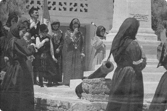
On 14 May 1824 an Egyptian squadron appeared; cannons were placed on the beaches and Cretans and Kasiots took up battle positions. On 27 May the rest of the fleet arrived under Ismael Gibraltar — 25 warships, about 40 transports and 4,000 soldiers. For three days the island was under fire and held out.
In the end, an unguarded path let the invaders get behind the defenders. Many Cretans were spirited away, but Kasos was given to the flames: around a thousand Kasiots were killed, while women and children were slaughtered or taken captive. This catastrophe is commemorated every year, on 7 June, with three days of memorial events.
Ever since that sacrifice the island bears the title “Heroic Island of Kasos”.
Modern history
The modern history of Kasos is an alternation of prosperity and disaster — with shipping always at its heart.